


I never expected to Google the cost of Tesla battery replacement and, even scarier, Tesla Model Y battery replacement cost, this soon.
I thought I had dodged one of the biggest fears of EV ownership.
Just a few months earlier, I’d completed one of the most remote EV road trips imaginable, driving my Tesla Model Y to the Arctic Ocean via Canada’s legendary Dempster Highway. Thousands of miles of gravel roads, river crossings, and isolated stretches with virtually no services, yet the Model Y never skipped a beat.
If the high-voltage battery had failed somewhere between Dawson City, Eagle Plains, Inuvik, and Tuktoyaktuk, the outcome would have been dramatically different.
A tow alone could have cost thousands of dollars, not to mention the challenge of finding transportation, accommodation, and a way to get the vehicle to the nearest Tesla Service Centre.
I wrote about that incredible adventure in my Dempster Highway EV road trip northbound report and Dempster Highway EV road trip southbound report. Looking back now, I’m incredibly thankful the battery survived that journey because the story you’re about to read could have had a very different ending.
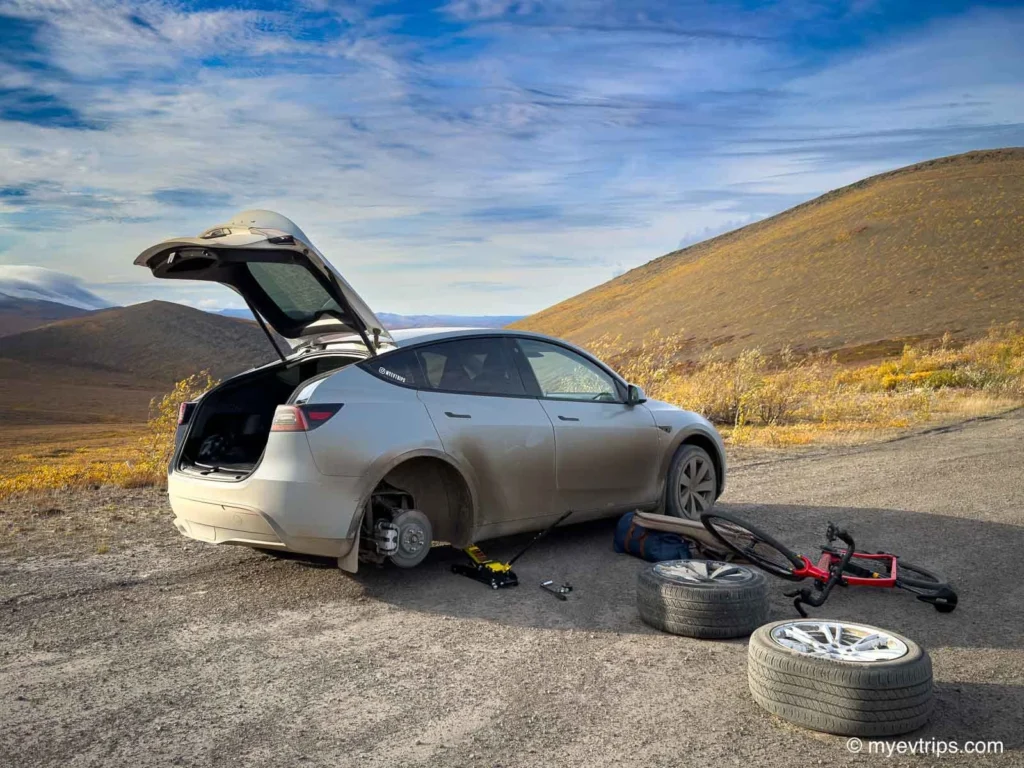
Instead, my Model Y decided to give up while I was running errands only a few miles from home.
If there’s ever a “good” time for your Tesla battery to fail, this was probably it.
That doesn’t mean it wasn’t stressful.
Only days later, I was scheduled to leave for another EV adventure, this time driving through Scandinavia. Between packing camera gear, preparing my Airbnb, organizing flights, and trying to check off an endless list of pre-trip errands, my Tesla suddenly informed me it could no longer charge properly.
Within minutes I was searching something every Tesla owner hopes they’ll never have to Google:
What is the cost of a Tesla battery replacement?
Unfortunately, I was about to find out.
My Tesla Model Y Battery Failed After Just 42,000 Miles
Yes, you read that correctly.
My Tesla Model Y’s high-voltage battery failed after only 42,000 miles.
Not 142,000.
Not 242,000.
Just 42,000 miles.
Considering Tesla batteries have earned a reputation for lasting hundreds of thousands of miles with relatively little degradation, this wasn’t something I ever expected to experience.
I’ve spent years road-tripping EVs all over North America, often taking them well beyond where many people think electric vehicles belong.
From winter driving in northern Canada to remote highways with almost no charging infrastructure, I’ve learned that careful planning usually makes EV travel much easier than people expect.
That’s what made this failure so surprising.
The battery had already survived one of the toughest road trips I’ve ever undertaken.
Then it failed while I was picking up supplies around town.
Sometimes technology has a strange sense of timing.
The Warning That Started It All
The first warning didn’t immediately send me into panic mode.
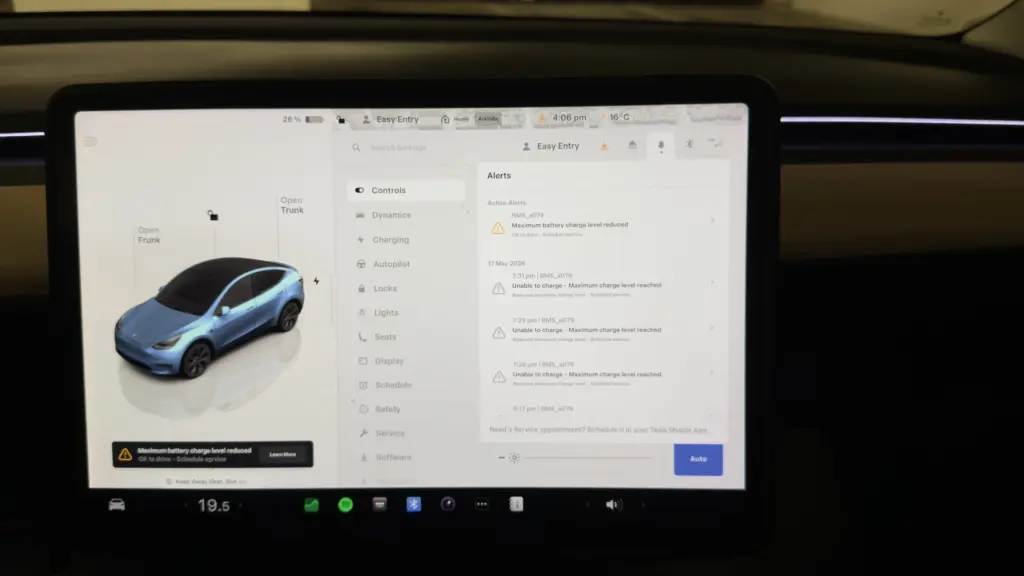
While driving around town, my Tesla displayed a message saying the vehicle was unable to charge beyond 50%.
Initially, I assumed it might be a temporary software issue or something that could wait until I returned from Scandinavia.
For local driving, 50% battery is still plenty.
I wasn’t commuting long distances. I was simply running errands, visiting Home Depot, buying supplies for my Airbnb, and getting everything ready before leaving the country.
It was frustrating.
But it still seemed manageable.
The following morning changed everything.
The car wouldn’t charge at all.
That’s when it became obvious this wasn’t going to fix itself.
Without the ability to recharge, an EV quickly becomes exactly what critics love to joke about—a very expensive paperweight.
Tesla Battery Error Codes BMS_a074 and BMS_a079
The two alerts displayed on my screen were:
- BMS_a074
- BMS_a079
If you’re reading this because one of those codes has just appeared on your own Tesla, I completely understand the feeling.
I was doing exactly what you’re probably doing now—searching online trying to figure out whether this was something minor or something that was about to become very expensive.
Both are Battery Management System (BMS) fault codes related to the vehicle’s high-voltage battery.
While Tesla doesn’t publicly explain every diagnostic code, owners commonly report that:
- BMS_a079 indicates the vehicle has reduced the maximum charge level or is no longer able to charge properly.
- BMS_a074 generally points toward reduced battery performance or another serious high-voltage battery fault.
In plain English, my Tesla had detected a significant problem inside the battery pack.
Tesla never told me exactly which module or component failed, so I won’t pretend to know.
What I do know is the final diagnosis.
The entire high-voltage battery pack needed to be replaced.
Not repaired.
Not recalibrated.
Replaced.
Why This Failure Was So Unusual
Whenever someone hears that a Tesla needed a brand-new battery after only 42,000 miles, it’s easy to assume Tesla batteries must be unreliable.
That wasn’t my conclusion.
In fact, it’s exactly why I decided to document the experience.
Battery degradation and battery failure are two completely different things.
Every lithium-ion battery slowly loses capacity over time. That’s normal, whether it’s inside your smartphone, laptop, or electric vehicle.
A Tesla gradually losing a few percent of range after tens of thousands of miles is expected. That’s why I regularly monitor mine, and if you’ve never checked yours, it’s worth learning how to perform a Tesla battery health check and understand battery degradation before you notice any issues.
A complete battery failure requiring an entirely new battery pack is something very different.
Most Tesla owners will never experience it.
Unfortunately, I did.
That doesn’t mean Tesla batteries are inherently unreliable.
Like every complex piece of technology, rare failures happen.
Could better charging habits have prevented this?
Honestly, I don’t know.
I already follow what Tesla recommends and have written extensively about Tesla charging best practices for better battery health, as well as a more technical guide covering Tesla battery best practices and lithium-ion battery science. Despite following those recommendations, my battery still failed.
Sometimes components simply fail.
The more important question isn’t whether failures can happen.
It’s how the manufacturer handles them when they do.
Thankfully, in my case, the answer turned out to be much better than I expected.
Tesla Model Y Battery Replacement Cost: The Number I Was Afraid to See
As soon as Tesla confirmed the high-voltage battery needed replacing, one thought immediately crossed my mind.
How much is this going to cost?
If you’ve searched for the Tesla Model Y battery replacement cost, you’ve probably seen estimates ranging anywhere from $12,000 to well over $20,000 USD, depending on the battery pack, labour, and whether Tesla installs a new or remanufactured battery.
That’s a frightening number for any vehicle owner.
In fact, outside the warranty period, replacing the battery can easily become the single most expensive repair most Tesla owners will ever face.
Industry estimates from Recurrent Auto place the cost of Tesla battery replacement at approximately $15,000 to $22,000 USD, while other repair estimates suggest some Model Y battery replacements fall closer to $12,000 to $16,000 USD, depending on battery chemistry, labour rates, and parts availability.
Even though I knew I should still be covered under Tesla’s Battery and Drive Unit Limited Warranty, there was still plenty of uncertainty.
There’s a huge psychological difference between believing something will be covered…
…and actually seeing the invoice.
When I handed over my keys, I honestly didn’t know which outcome I was going to get.
That uncertainty made the next few days feel much longer than they really were.
Booking Tesla Service in Panic Mode
Once the car stopped charging completely, I immediately booked a service appointment through the Tesla app.
Like most Tesla owners, I opened the app hoping there would be an appointment available the next morning.
There wasn’t.
Normally, waiting a week or two for a service appointment wouldn’t have been a huge issue. But this wasn’t a squeaky suspension or a broken trim clip.
My car couldn’t charge.
Even worse, I was only days away from leaving for Scandinavia.
The timing couldn’t have been much worse.
If you’ve ever prepared for a long international trip, you know how chaotic those final few days can be. I was finishing work, packing camera gear, getting my Airbnb ready for guests, and making sure everything was organized before being away for several weeks.
Ironically, I’ve spent years writing about EV road trips and how proper planning makes them surprisingly easy. Whether it’s making sense of EV charging apps and maps or carrying the best Tesla charging adapters and cables for a Model Y, I always try to prepare for the unexpected.
A complete battery failure wasn’t something I could prepare for.
Fortunately, Tesla’s service team was far more accommodating than I expected.
After explaining that the vehicle was no longer accepting a charge and that I was leaving the country in just a few days, they managed to move my appointment forward.
That alone took a huge amount of stress off my shoulders.
Rather than leaving my Model Y sitting at home with an unknown battery issue while I was overseas, I could at least get it into the hands of Tesla technicians before boarding my flight.
Was My Tesla Model Y Battery Replacement Covered Under Warranty?
The next question was the one every EV owner worries about.
Would Tesla actually cover the battery replacement?
I was fairly confident the answer was yes.
My Model Y had only 42,000 miles on it, putting it comfortably inside Tesla’s Battery and Drive Unit Limited Warranty.
For most Model Y variants, Tesla provides battery coverage for 8 years or 120,000 miles, whichever comes first. Rear-Wheel Drive models receive 8 years or 100,000 miles, again whichever comes first. Tesla also guarantees the battery will retain at least 70% of its original capacity during the warranty period.
Still, knowing what the warranty says and seeing the final invoice are two very different things.
Until the repair was complete, there was always that little voice in the back of my mind wondering whether Tesla would find some reason the repair wasn’t covered.
Thankfully, they didn’t.
Waiting for the Diagnosis
When I dropped the car off, I expected a long wait.
Initially, it sounded like the replacement battery might not even arrive before I left for Scandinavia.
That wasn’t ideal, but it was understandable.
A complete high-voltage battery replacement isn’t exactly a common inventory item sitting on a shelf waiting for the next customer.
I resigned myself to the possibility that I’d be halfway around the world before hearing anything.
Then things took an unexpected turn.
While checking in at the Service Centre, I was told the replacement battery was already expected to arrive the following day.
If everything went according to plan, the installation would be completed before the end of the week.
Even better, that meant my Model Y might actually be ready the day before my flight.
After spending the previous 48 hours imagining every possible outcome, this was the first genuinely good news I’d received.
The Biggest Surprise: Tesla Installed a Brand-New Battery
This was the part that surprised me most.
Before dropping off the car, I’d done plenty of reading about Tesla battery replacement.
One thing that kept coming up was that Tesla often installs refurbished or remanufactured battery packs for warranty claims. That made sense to me, and honestly, I would’ve been perfectly happy with one.
After all, a functioning battery that costs me nothing is still an excellent outcome.
Instead, when I returned to collect the vehicle, the advisor told me something I wasn’t expecting.
Tesla had installed a brand-new high-voltage battery.
That completely changed how I felt about the entire experience.
Don’t get me wrong—it was still concerning that my original battery failed after only 42,000 miles.
There’s no sugar-coating that.
But replacing the most expensive component in the vehicle with a brand-new battery effectively gave the car a fresh start.
In a strange way, I drove away feeling like I had a much newer vehicle than the one I’d dropped off.
The Final Tesla Model Y Battery Replacement Cost
After days of wondering whether I was about to receive the biggest repair bill of my life, Tesla finally handed me the invoice.
I looked straight at the total.
$0.
No deductible.
No diagnostic charge.
No labour costs.
No unexpected surprises buried in the paperwork.
Tesla covered the entire battery replacement under warranty.
Considering many out-of-warranty estimates place the Tesla Model Y battery replacement cost well into five figures, seeing that total was an enormous relief.
It’s one thing to read about Tesla’s warranty online.
It’s another to experience it firsthand when the most expensive component in your vehicle suddenly fails.
That invoice reminded me just how valuable the battery warranty really is—especially for anyone considering buying a used Tesla.
If you’re shopping for a pre-owned Model Y, I’d look at three things before anything else: remaining battery warranty, service history, and overall battery health. Those are far more important than a few cosmetic scratches or an extra set of wheels.
Tesla Battery Replacement: What If This Had Happened on the Dempster Highway?
This is the part I keep coming back to.
A few months before my battery failed, I had driven my Model Y to the Arctic Ocean via the Dempster Highway. If you’ve never driven it, it’s one of the most remote highways in North America and one of the ultimate tests for both driver and vehicle.
You can follow that adventure in my Dempster Highway EV road trip northbound report and the return journey in my Dempster Highway EV road trip southbound report.
Looking back, I realize just how lucky I was.
Had this exact battery failure happened somewhere between Eagle Plains and Inuvik—or worse, after reaching Tuktoyaktuk—the situation would have gone from inconvenient to potentially trip-ending.
Unlike a flat tire or a broken windshield, a failed high-voltage battery isn’t something you can limp along with.
Once my Model Y stopped accepting a charge, that was it.
The trip would have been over.
I would have been looking at an incredibly expensive tow, trying to coordinate transportation hundreds of miles from the nearest Tesla Service Centre, rearranging accommodations, changing flights, and waiting days—or possibly weeks—for repairs.
It’s the sort of scenario every overlander thinks about but hopes never happens.
Fortunately, it didn’t.
Instead, the battery chose to fail while I was a few miles from home, where getting the car to Tesla was little more than an inconvenience.
Sometimes luck is every bit as important as preparation.
Does This Change My Opinion of EV Road Trips?
Not at all.
If anything, it reinforced something I’ve learned after thousands of miles of electric road trips.
Preparation solves most problems.
Mechanical failures are a different story.
I’ve written extensively about making sense of EV charging apps and maps because choosing the right charging stops can make or break a trip. Likewise, understanding EV charging station etiquette and best practices makes travelling smoother for everyone using the network.
Those things are within your control.
A random battery failure isn’t.
No amount of route planning, PlugShare reviews, or backup charging locations would have prevented what happened to my Model Y.
That’s simply part of owning any vehicle.
Gas cars suffer engine failures.
Diesel trucks lose transmissions.
EVs can occasionally have battery failures.
They’re all rare, but they happen.
The difference is that people tend to hear about every EV battery failure because it’s still something of a novelty.
Would I Still Drive My Tesla to Remote Places?
Absolutely.
In fact, this experience hasn’t changed my travel plans one bit.
A few months before the battery failure, I’d driven thousands of miles through northern Canada without a single issue. I’ve also completed road trips throughout British Columbia, Alberta, Yukon, and the Northwest Territories, proving that EV travel is not only possible but incredibly enjoyable when you plan properly.
If you’re curious what EV travel in some of Canada’s most remote regions actually looks like, I’d recommend reading about my Northern Canada by EV: Yellowknife to Edmonton road trip. It’s another great example of how far EV infrastructure has come in places many people assume are impossible to reach.
Closer to home, my Sunshine Coast EV road trip loop remains one of my favourite drives and shows just how relaxing EV travel can be when charging naturally fits into your itinerary.
This battery failure hasn’t changed those experiences.
It has simply reminded me that no vehicle—electric or gasoline—is immune from the occasional unexpected mechanical problem.
Should You Be Worried About Tesla Battery Failure?
My answer is both yes and no.
Yes, because what happened to me is obviously concerning.
No one expects the most expensive component in their vehicle to fail after only 42,000 miles.
But no, because this still isn’t representative of the typical Tesla ownership experience.
Most owners will never need a complete battery replacement.
What they’re much more likely to experience is gradual battery degradation over many years of driving.
That’s why I always recommend checking your battery’s health periodically instead of waiting until something goes wrong. My guide to Tesla battery health checks and battery degradation walks through exactly how to establish a baseline and monitor long-term battery performance.
It’s also worth following sensible charging habits. While good habits can’t prevent every failure—as my own experience clearly shows—they can help maximize battery longevity. If you haven’t already, I recommend reading my guides on Tesla charging best practices for better battery health and Tesla battery best practices: a lithium-ion deep dive.
Neither article promises to eliminate failures.
Nothing can.
But they can help you get the most from your battery over the long term.
If there’s one lesson this experience reinforced, it’s that battery warranties matter almost as much as the battery itself.
Whether you’re buying new or used, understanding exactly what’s covered could save you thousands of dollars if you ever find yourself in the same situation I did.
What I Learned From My Tesla Model Y Battery Replacement
After everything was over, I found myself thinking less about the battery failure itself and more about what I learned from the experience.
The first lesson is simple.
Battery warranties matter.
Until you’re staring at the possibility of a five-figure repair bill, it’s easy to overlook the value of Tesla’s Battery and Drive Unit Limited Warranty. Had this happened a few years later and outside the warranty period, the outcome could have been very different.
Instead, Tesla replaced the most expensive component in my vehicle at no cost.
That’s not something I take for granted.
The second lesson is that where something fails can be just as important as what fails.
If this battery had given up during my drive to the Arctic Ocean, or while exploring northern Canada, I’d have been facing far more than a repair bill. I would’ve been dealing with towing logistics, accommodation changes, cancelled plans, and potentially ending a trip I’d spent months planning.
After driving some of the most remote highways in Canada—including my Northern Canada by EV road trip from Yellowknife to Edmonton—I have an even greater appreciation for how fortunate I was that this happened close to home.
The third lesson surprised me.
Tesla’s customer service exceeded my expectations.
I’ve read plenty of stories online ranging from excellent experiences to frustrating ones, so I wasn’t sure what to expect. In my case, the Service Centre recognized that my car wouldn’t charge, understood I had international travel planned, moved my appointment forward, sourced a replacement battery quickly, and completed the repair before I left for Scandinavia.
Could the communication have been better at times?
Probably.
But when it came to the outcome, I honestly couldn’t have asked for much more.
Would I Buy Another Tesla?
This is probably the question many readers have been waiting for.
After having a complete high-voltage battery fail after only 42,000 miles…
Would I buy another Tesla?
Yes.
Without hesitation.
That answer might surprise some people, especially after reading everything above.
Here’s why.
Every manufacturer builds the occasional defective component.
Gasoline vehicles suffer catastrophic engine failures.
Transmissions fail.
Turbochargers fail.
Head gaskets fail.
Those failures don’t automatically make an entire brand unreliable.
The same logic applies to electric vehicles.
While my battery failure was undoubtedly frustrating, Tesla stood behind its warranty, replaced the battery with a brand-new pack, and returned my car without charging me a cent.
That experience actually increased my confidence in owning the vehicle long term.
Would I have preferred the original battery never failed?
Of course.
But now I have a brand-new high-voltage battery installed by Tesla, and I can continue doing what I bought the Model Y for in the first place—taking it on road trips.
Advice for Anyone Buying a Used Tesla Model Y
If you’re shopping for a used Tesla, this experience reinforced a few things I’d personally check before handing over any money.
I’d want to know:
- How much Battery and Drive Unit warranty remains?
- Has the vehicle ever had any major battery repairs?
- What’s the current battery health?
- Has the car displayed any recurring charging or battery-related warnings?
- Has it primarily been Supercharged, or AC charged at home?
- Does the service history show any previous battery or drive unit work?
I’d also spend a little time learning how the previous owner treated the battery.
While charging habits probably didn’t cause my failure, following sensible charging practices is still one of the best ways to maximize long-term battery health. If you’re new to Tesla ownership, my guides covering Tesla charging best practices and a deeper look at lithium-ion battery best practices are good places to start.
If you’re planning longer road trips, don’t overlook your charging gear either. Carrying the best Tesla charging adapters and cables for a Model Y has saved me more than once, especially when travelling outside major Supercharger corridors.
And if you live somewhere with real winters like I do, it’s also worth understanding how cold weather affects EV range and winter driving. Winter won’t suddenly destroy your battery, but it absolutely changes how you plan, charge, and travel.
For me, this experience didn’t change my enthusiasm for EV road trips.
It simply reinforced something I’ve always believed.
Plan well.
Understand your vehicle.
Know what’s covered under warranty.
Then get out there and enjoy the drive.
Final Thoughts: The Worst EV Failure at the Best Possible Time
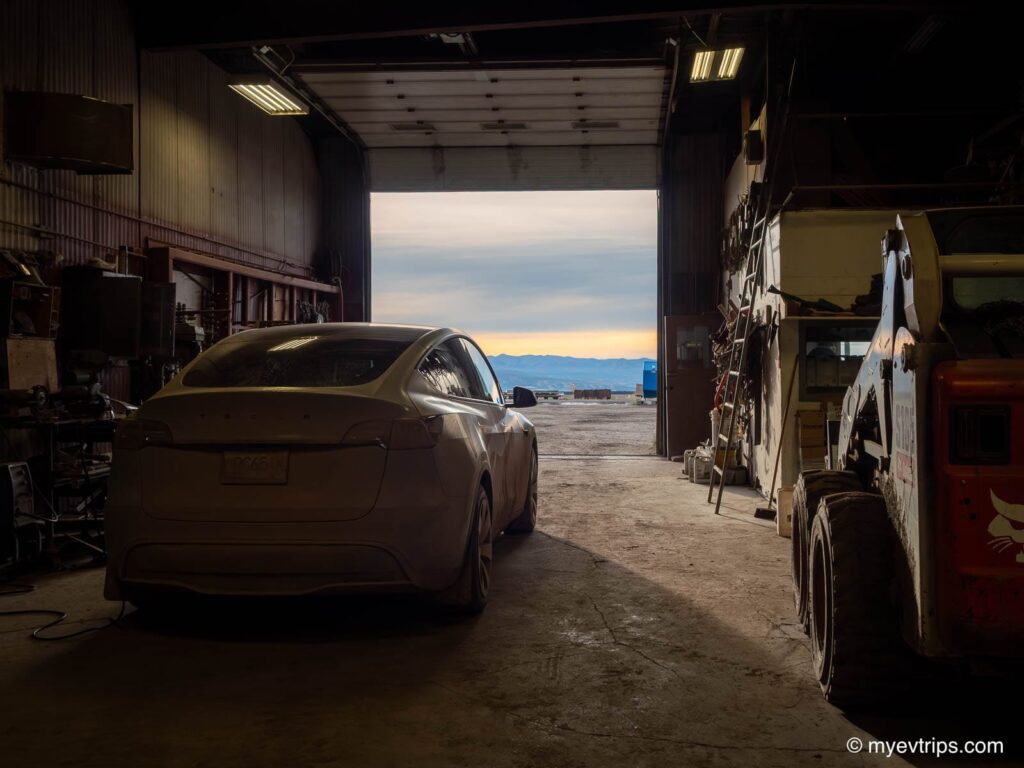
When people ask me about my Tesla Model Y now, this story almost always comes up.
Not because it changed my opinion of electric vehicles.
Because it reminded me that even the most reliable vehicles can have an unexpected bad day.
Would I have preferred my battery to last hundreds of thousands of miles without a problem?
Absolutely.
No one wants to hear they need a brand-new high-voltage battery after only 42,000 miles.
But after taking a step back, I realized how fortunate I actually was.
The battery didn’t fail halfway to the Arctic Ocean.
It didn’t fail on a remote stretch of the Dempster Highway where recovery could have taken days and cost thousands of dollars.
It didn’t fail while driving across northern Canada, where I would’ve been hundreds of miles from the nearest Tesla Service Centre. Looking back on my Northern Canada by EV road trip, I have an even greater appreciation for just how isolated parts of that journey really were.
Instead, it failed a few miles from home.
Tesla moved up my appointment, diagnosed the issue quickly, replaced the battery under warranty, and surprised me by installing a brand-new battery pack instead of a refurbished one.
Most importantly, they handed me back the keys with an invoice showing $0.
That’s a very different ending than I had imagined when those battery warning messages first appeared.
Will this experience stop me from taking long EV road trips?
Not a chance.
I’ve driven my Model Y across some incredible places, and I already have plenty more adventures planned. Experiences like my Sunshine Coast EV road trip loop remind me why I enjoy travelling by EV so much. The journey becomes part of the adventure, not just the drive between destinations.
If there’s one takeaway from this experience, it’s this:
Understand your warranty.
Pay attention to battery warning messages.
Follow good charging habits.
And don’t let one rare story convince you that every Tesla battery is destined to fail.
Mine did.
Most won’t.
If my Tesla battery had to fail, I’m incredibly grateful it happened exactly when and where it did—close to home, fully covered under warranty, and not halfway to the Arctic Ocean.
FAQ: Tesla Model Y Battery Replacement Cost
How much does a Tesla Model Y battery replacement cost?
The Tesla Model Y battery replacement cost can vary depending on the battery pack, model year, labour rates, and whether Tesla installs a new or remanufactured battery.
Based on published estimates and real-world repair invoices, an out-of-warranty cost of a Tesla battery replacement is typically between $12,000 and $20,000 USD, although more complex repairs can exceed that. Fortunately, my Model Y was still covered under Tesla’s Battery and Drive Unit Limited Warranty, so my out-of-pocket cost was $0.
How long is the Tesla Model Y battery warranty?
Tesla’s Battery and Drive Unit Limited Warranty covers the Model Y for 8 years, with either 100,000 or 120,000 miles, depending on the trim level. Tesla also guarantees a minimum of 70% battery capacity retention during the warranty period. Since my battery failed after only 42,000 miles, it qualified for a full warranty replacement.
What is the Tesla Model Y battery warranty in Canada?
Tesla Canada lists the Model Y Battery & Drive Unit warranty as 8 years or 192,000 km for some trims and 8 years or 160,000 km for the Model Y Standard RWD, whichever comes first.
Should I avoid buying a Tesla because of battery replacement cost?
Not necessarily. Battery replacements are expensive outside warranty, but failures like mine are not the norm. The key is to understand the remaining warranty, check battery health, and take warning messages seriously.
What do Tesla error codes BMS_a074 and BMS_a079 mean?
Both BMS_a074 and BMS_a079 are Battery Management System (BMS) fault codes related to the high-voltage battery. In my case, the warnings initially limited charging to 50% before the vehicle stopped charging altogether. Tesla diagnosed the issue and determined that the entire high-voltage battery pack needed to be replaced.
Can good charging habits prevent Tesla battery failure?
Not always. While following Tesla charging best practices and understanding lithium-ion battery best practices can help maximize battery longevity, they can’t prevent every failure.
I followed recommended charging habits, yet my battery still failed after 42,000 miles. Good habits reduce stress on the battery but can’t eliminate the possibility of an unexpected component failure.
SAVE ON A NEW TESLA!
Thinking of buying a Tesla? Use this referral link to get up to $1,300 off!*
*As of August 2024, Tesla has reinstated its referral program and introduced attractive financing options!


Another reason not to buy a rebuilt title Tesla …any type of warranty would be voided!