

Driving the Dempster Highway electric vehicle route was by far the most ambitious road trip I’ve attempted to date—and without question one of the most rewarding.
I’ve completed a number of long EV adventures across Canada, including remote northern drives through Alberta and the Northwest Territories, but nothing compares to pointing an electric vehicle north from Dawson City and heading toward the Arctic Ocean on one of the most remote highways in North America.
The Dempster Highway stretches roughly 740 km (460 miles) from Dawson City in the Yukon to Inuvik in the Northwest Territories, with an additional 138 km extension to Tuktoyaktuk on the Arctic Ocean.
That makes it the only public road in Canada that reaches the Arctic Ocean year-round.
Doing this drive in a gas vehicle would already be an adventure. Attempting a Dempster Highway electric vehicle trip adds an entirely different level of planning.
Charging infrastructure is limited. Weather can change quickly. And there are stretches where you’re hundreds of kilometres from services.
But with preparation, patience, and the right gear, the Dempster Highway electric vehicle journey becomes one of the most unforgettable EV road trips you can do.
That said, and a big word of caution, this trip is not for everyone. An abundance of caution and planning needs to take place.
With that in mind, here are 10 things you need to know before driving the Dempster Highway in an electric vehicle.
1. Plan Charging Stops for Your Dempster Highway Electric Vehicle Trip
Planning charging stops is EV road trip planning 101, but when attempting a Dempster Highway electric vehicle trip, it becomes absolutely essential.

Unlike most highways in North America, there are very few reliable charging options along the route. Many chargers are destination units installed by local businesses or communities, and some rely on RV-style outlets.
Because of this, you should never rely entirely on charging apps.
Before arriving at any charger along the Dempster Highway electric vehicle route, always:
• Call ahead
• Confirm the charger works
• Ask if it’s turned on
• Verify payment expectations
During my trip the charger at Eagle Plains had reportedly been offline for months. After several calls and coordination with another EV driver traveling the highway at the same time—a Rivian owner—we finally figured out the problem.
The faceplate on the charger had been screwed on too tightly. Once loosened slightly, the indicator light switched from blue to green and the charger immediately started working.
Another example involved Polar Tires in Inuvik. Although a charger is listed online, the owner no longer allows EV drivers to use it. Even after purchasing a tire there for nearly $500, I was told I couldn’t plug in while waiting.
Situations like this reinforce why careful planning is critical.
I documented every charging stop and range calculation in my northbound Dempster Highway EV road trip report and the southbound Dempster Highway return trip report.
2. Bring Every EV Charging Adapter You Own
When tackling the Dempster Highway electric vehicle route, adapters become your lifeline.
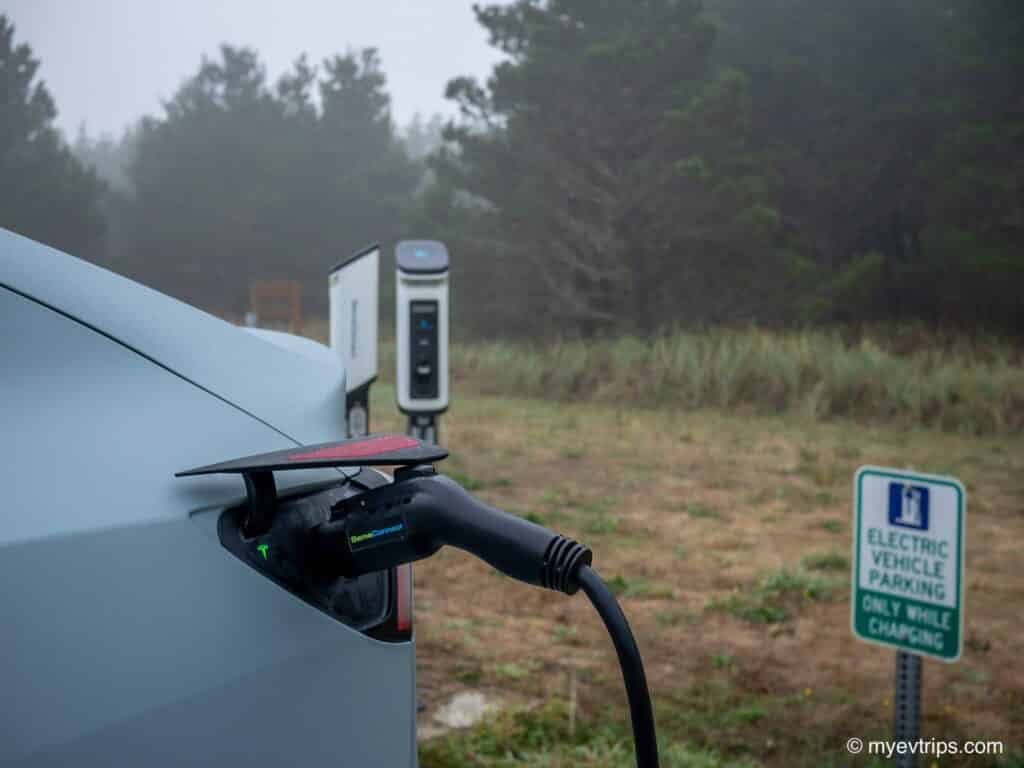
Charging options vary widely, and during my trip I used several different outlets including:
• NEMA 6-50
• NEMA 14-50
• TT-30 campground hookups
• standard 110V outlets
For remote EV travel like this, it’s worth reviewing my guide to the best Tesla EV charging adapters and cables.
Some adapters worth carrying include a NEMA 14-50 charging adapter, a TT-30 RV campground adapter, and a heavy-duty 14-50 extension cord.
It’s also smart to carry both a J1772 charging adapter and a CCS fast charging adapter.
While talking with mechanics at Eagle Plains, they told me about a Tesla driver who arrived without any adapters at all.
That driver had to charge for four days on a standard wall outlet before continuing the trip.
On a road like the Dempster, that kind of mistake can completely derail your adventure.
3. Bring a Full-Size Spare Tire (Or Two)
The Dempster Highway has a reputation for destroying tires.
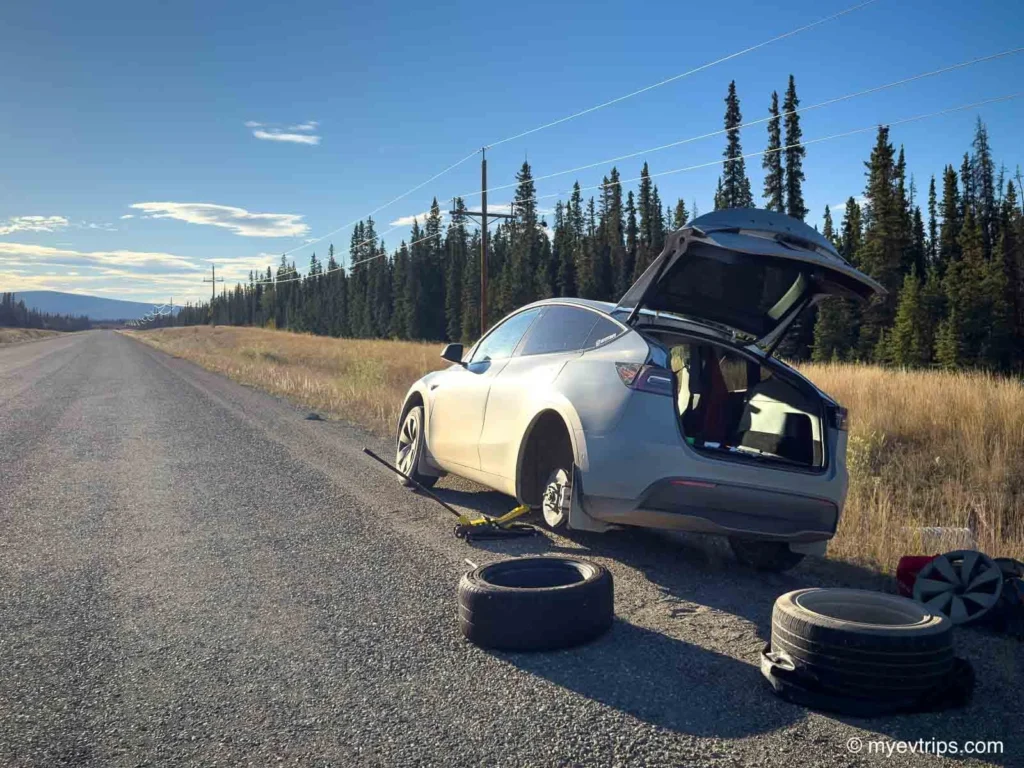
The road surface uses sharp crushed shale that can easily puncture regular tires.
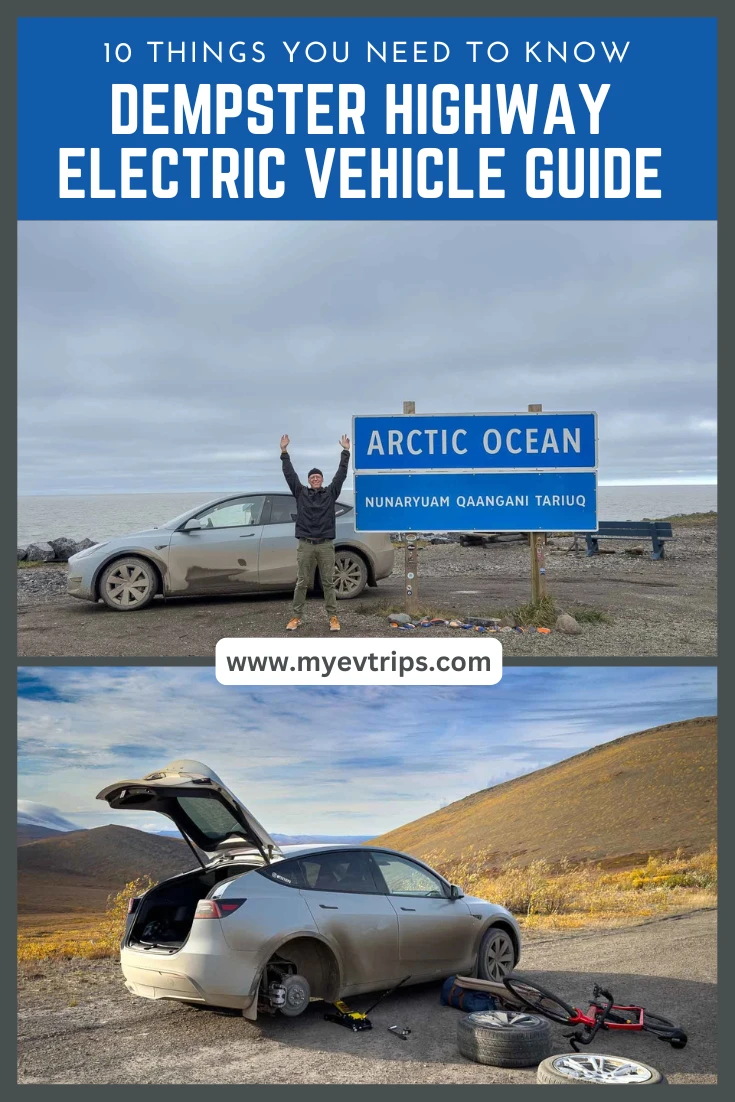
Before I even reached the highway I experienced a flat tire. At first I assumed it was the shale claiming its first victim.
Instead it turned out to be something bizarre—a trailer hitch pin embedded in the tire.
Later in the trip, however, the shale did get one.
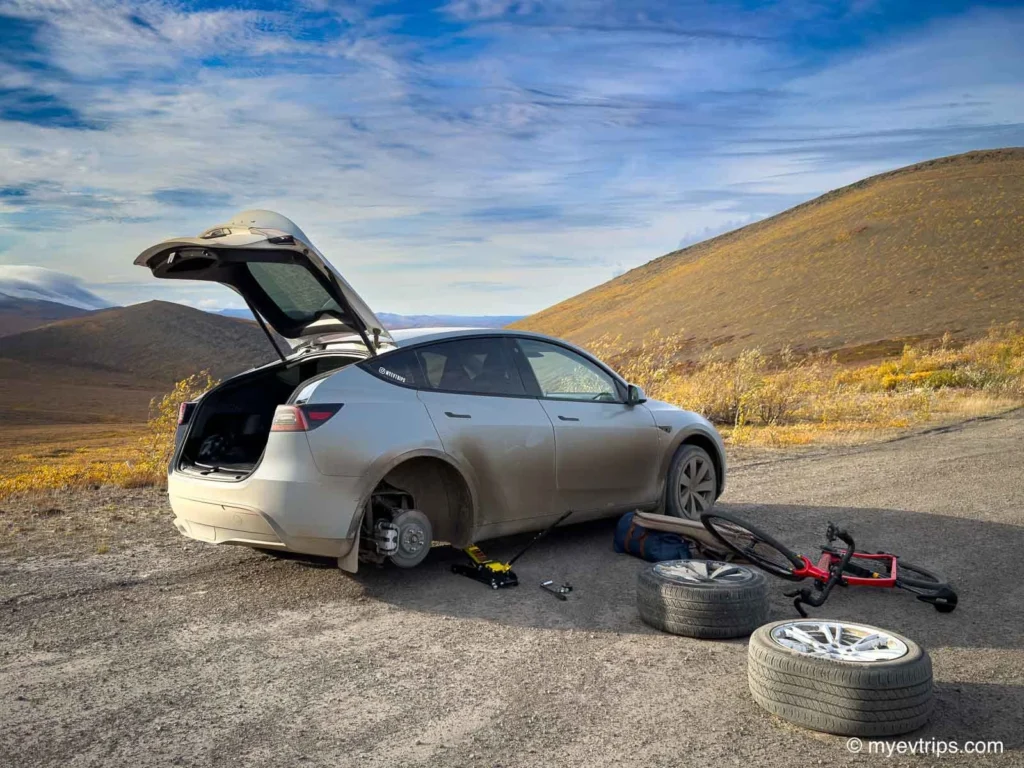
In hindsight, I would have brought two full-size spare tires instead of one.
Helpful tools to carry include a portable tire pump, a tire repair patch kit, and a heavy-duty 2-ton tire jack.
When attempting a Dempster Highway electric vehicle adventure, you should assume you’ll need to handle tire issues yourself.
4. Equip the Right Tires for the Dempster
For my trip I used the stock Tesla Model Y Gemini wheels because I was concerned about maximizing range between Dawson City and Eagle Plains.
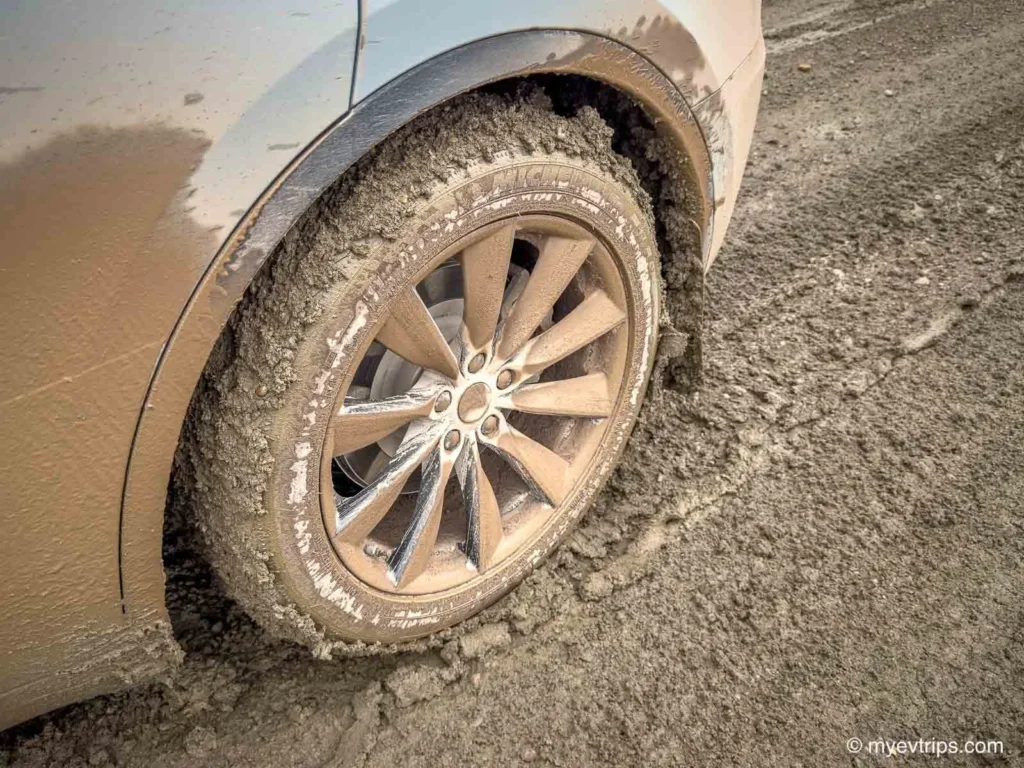
Looking back, I probably should have used my winter tire setup instead.
They were more rugged, less worn, and better suited to gravel roads.
If you’re evaluating tire options for trips like this, my breakdown of Tesla Model Y winter tires for EV road trips may help.
5. Drive Slow to Maximize Range
Speed kills EV range—and on the Dempster it can also destroy tires.
Some stretches between charging opportunities require careful energy management.

During one leg of my Dempster Highway electric vehicle journey, I drove between 40–60 km/h just to ensure I would reach Eagle Plains.
I arrived with only 4% battery remaining.
Meanwhile, a Rivian driver I encountered rolled in with 0% battery on another stretch of highway.
Moments like this highlight why it’s important to understand your vehicle’s battery condition before long remote drives. Running a Tesla battery health and degradation test before attempting trips like this can give you a better understanding of your real-world capacity.
Driving slower also reduces the chance of picking up sharp rocks.
Keeping speeds below 70 km/h significantly lowers the risk of punctures.
6. Bring Starlink for Connectivity
Cell service along the Dempster Highway electric vehicle route is nearly nonexistent.
For about 99% of the highway, you will not have signal.
On a whim I purchased a Starlink unit before leaving. It ended up becoming one of the most valuable tools on the entire trip.
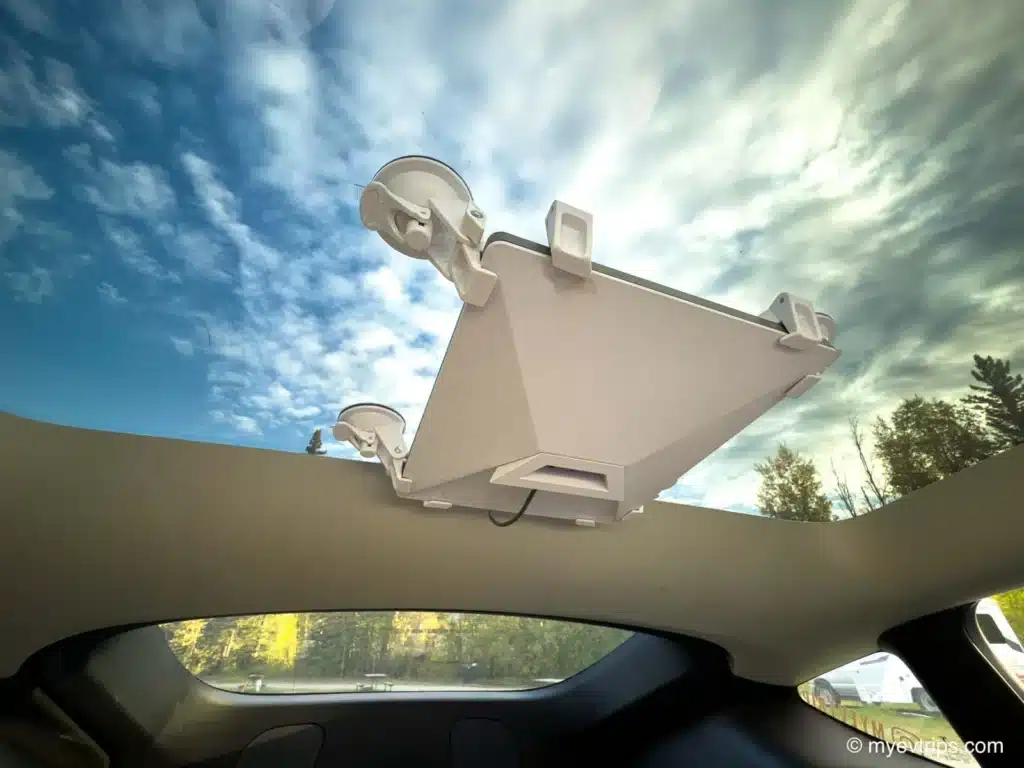
I mounted the dish to my Tesla’s glass roof using suction cups from inside the car, and it held perfectly even over rough gravel roads.
If you’re planning remote travel like this, you can order a Starlink setup for road trips.
I also documented my installation in my guide to installing Starlink in a Tesla for internet on the go.
7. Bring a Portable Battery Pack
Although Starlink can run off the Tesla’s AC outlet, I preferred to power it using a separate battery pack.
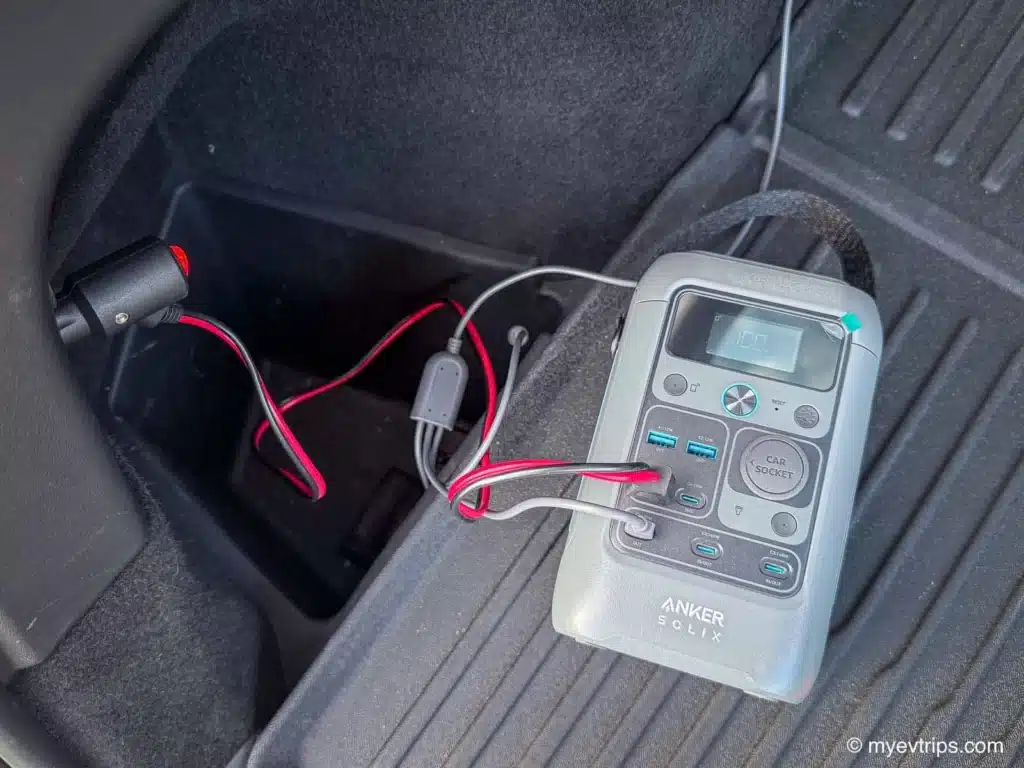
This allowed me to also power:
• Starlink
• camera gear
• a cooler
Without drawing energy from the vehicle battery.
For long EV trips, a Tesla trunk cooler for road trips is another great addition.
8. Always Pay for Charging
Electricity costs significantly more in northern communities.
Unfortunately, some EV drivers have plugged into outlets without permission in the past, which has caused frustration among business owners.
Whenever possible:
• ask permission
• offer payment
• leave contact details
Respecting communities helps ensure the Dempster Highway electric vehicle route remains accessible for future EV travelers.
9. Add Buffer Days for Weather
Weather along the Dempster can change quickly.
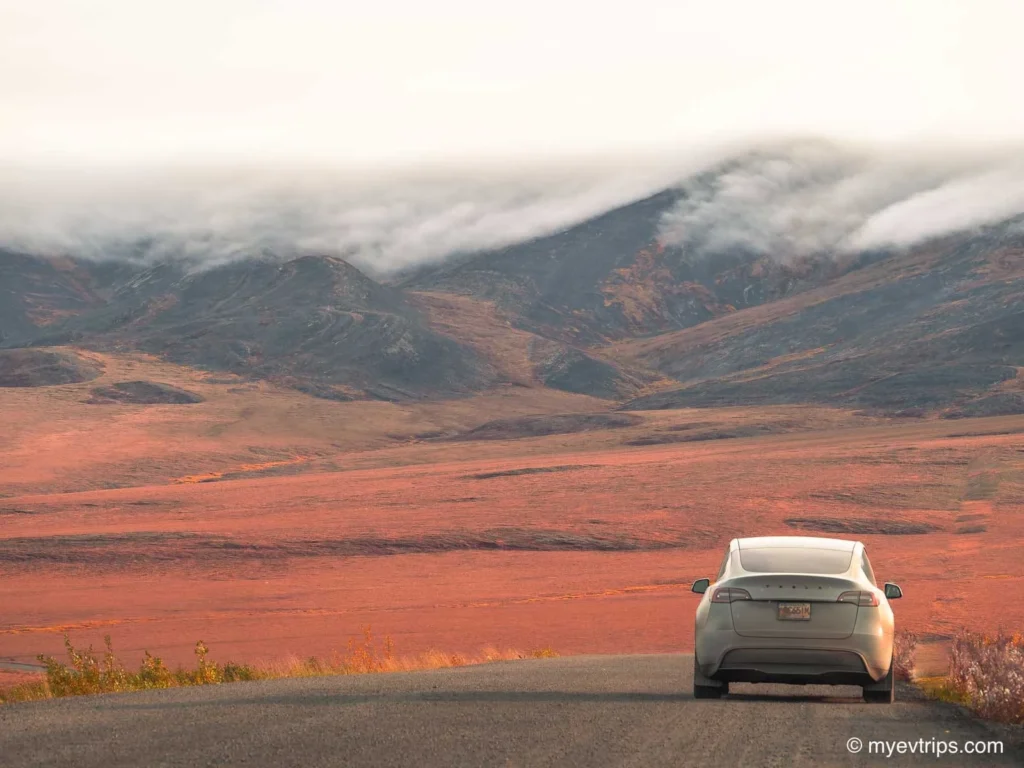
Rain turns the road into thick mud that dramatically affects traction and energy consumption.
During my trip the weather was fantastic, but a friend driving ahead of me encountered heavy rain and near-impassable roads just hours earlier.
Another EV traveler attempting the route was reportedly stranded three days after a ferry crossing washed out.
Always build at least three buffer days into your itinerary.
10. Protect Your Vehicle from Dust and Gravel
The Dempster Highway is hard on vehicles.
Dust and gravel find their way into every gap.
Before attempting my Dempster Highway electric vehicle trip, I installed a Tesla door seal kit for dust protection, a charging port dust cap, and a J1772 charging port cover.
Inside the vehicle I also used high-coverage all-weather floor mats to contain mud and gravel.
Dempster Highway EV Charging Map & Locations
One of the most common questions when planning a Dempster Highway electric vehicle trip is where you can actually charge.
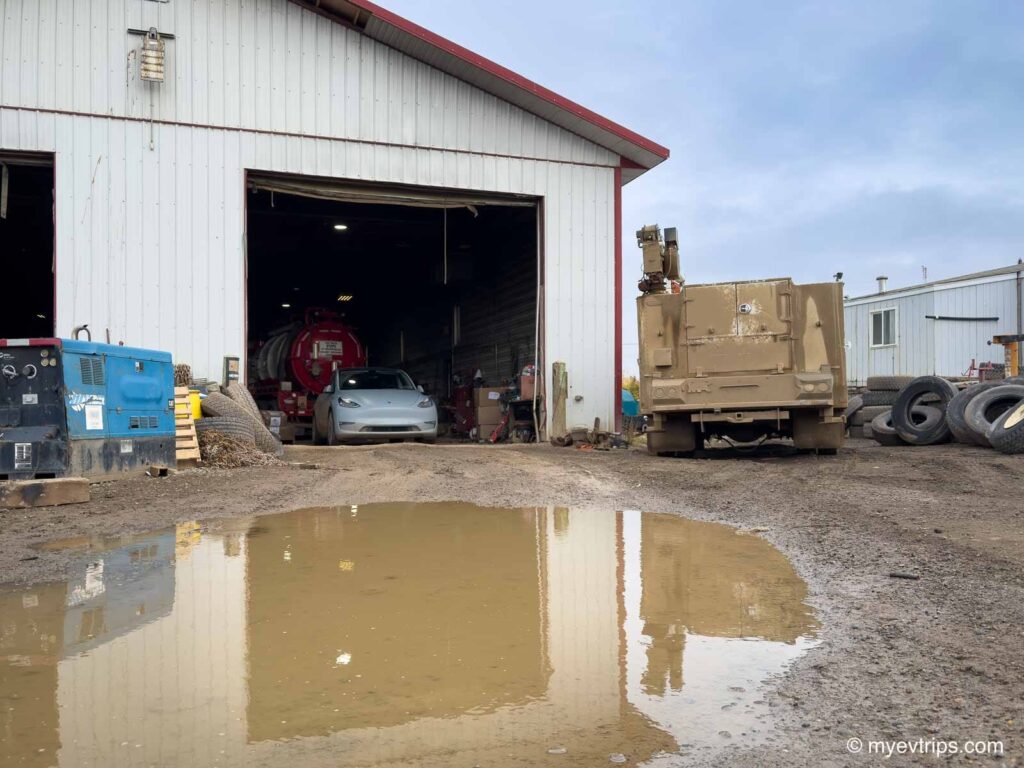
The primary charging stops include Dawson City, Eagle Plains, Fort McPherson, and Inuvik.
Dawson City is the last major town before starting the highway. I stayed at the Coast Hotel Dawson City before beginning the drive.
Eagle Plains is the halfway point and the most important charging stop. If you’re planning to stay overnight, check rates at the Eagle Plains Hotel.
Once you reach Inuvik, there are better accommodation options including Capital Suites Inuvik.
EV Range Needed for Each Dempster Highway Segment
Understanding range requirements is critical when planning a Dempster Highway electric vehicle trip.
Key driving segments include:
Dawson City → Eagle Plains ~405 km
Eagle Plains → Fort McPherson ~185 km
Fort McPherson → Inuvik ~190 km
Inuvik → Tuktoyaktuk ~138 km
Driving slowly and planning charging carefully are essential for these long distances.
EV Interview: Joseph Quigley’s Chevy Bolt Dempster Highway Trip
While planning my Dempster Highway electric vehicle journey, I connected with fellow EV adventurer Joseph Quigley, who completed the route in a Chevy Bolt EV.
I interviewed Joseph for MYEVTrips about his experience driving an electric vehicle to the Arctic Ocean. You can read that conversation in my Chevy Bolt Arctic Ocean EV road trip interview with Joseph Quigley.
Our conversation reinforced something important.
This trip is no joke.
Driving the Dempster Highway in an EV requires serious planning, proper equipment, and a strong understanding of range management.
Joseph later invited me onto his YouTube channel where we continued the discussion and compared our experiences driving electric vehicles to the Arctic Ocean.
I’ll embed the YouTube video of that conversation here so readers can hear firsthand what it takes to complete a Dempster Highway electric vehicle adventure.
Best Time of Year to Drive the Dempster Highway in an EV
The Dempster Highway is open year-round, but the best time to attempt a Dempster Highway electric vehicle trip is typically between June and early September.
Summer offers long daylight hours and warmer temperatures, which can help improve EV efficiency.
However, my trip took place during the fall shoulder season, which turned out to be spectacular.
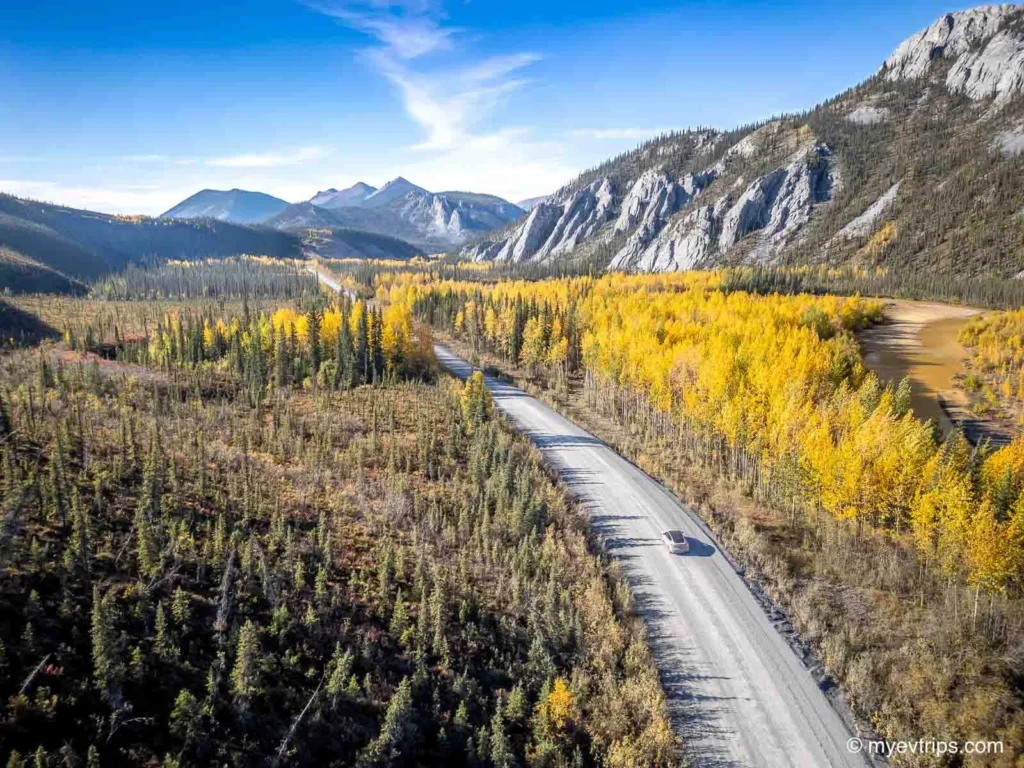
The tundra exploded with color, transforming the landscape into a mix of gold, red, and orange.
Driving through Tombstone Territorial Park during peak fall colours was one of the most stunning road trip experiences I’ve ever had.
The tradeoff with fall travel is colder temperatures and the potential for sudden weather changes, so planning extra buffer days becomes even more important.
Conclusion: One of the Greatest EV Road Trips in North America
Completing the Dempster Highway electric vehicle journey was one of the most incredible road trips I’ve ever taken.
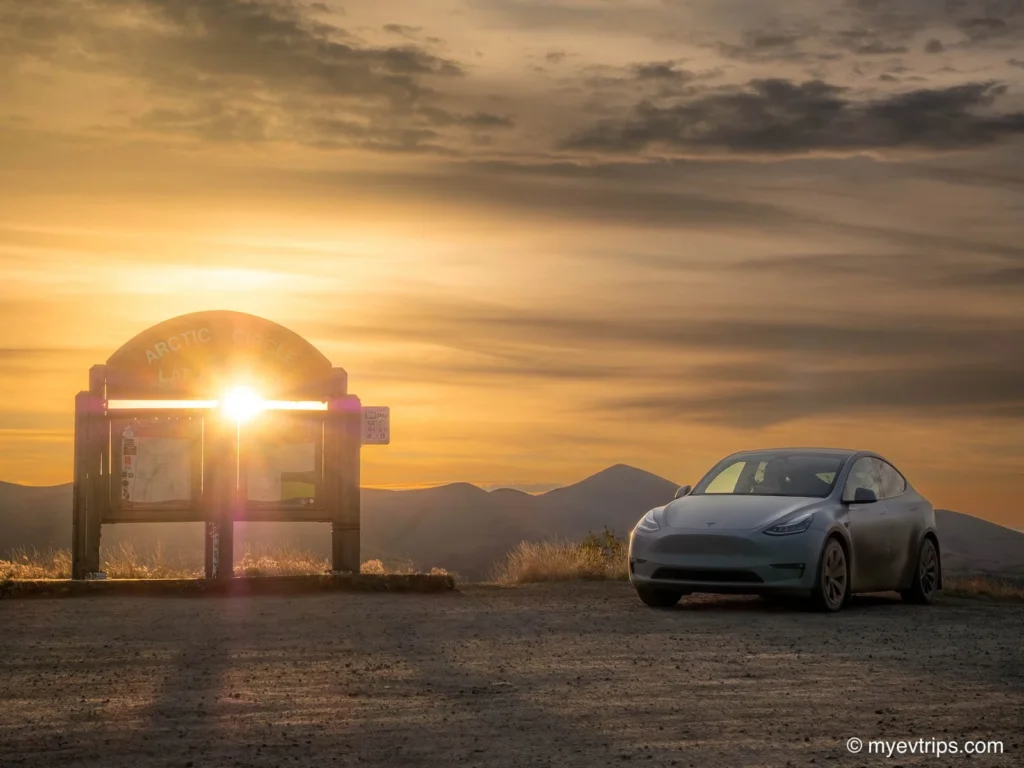
The combination of remote landscapes, northern communities, and the challenge of reaching the Arctic Ocean by electric vehicle made every kilometre memorable.
If you’re planning your own adventure, start with my full northbound Dempster Highway EV trip report and the southbound return journey breakdown.
With the right preparation and respect for the road, the Dempster Highway electric vehicle adventure proves something remarkable.
Electric vehicles can go almost anywhere.
Even the Arctic Ocean.
All images provided by Joseph Quigley & Micah Leier